
Summary
Learn how three companies are utilizing NLP to improve customer, employee and patient experiences.
Read time: 5 minutes
Every business wants to stand out for the right reasons. While expertise, service and innovation all play a role, the way you use technology can be a powerful differentiator that helps set your business apart from the competition.
In our last innovation blog on natural language processing (NLP), we looked at the landscape of AI investments and growth as well as the types of data and use cases that are ripe for improvement. In this second article on NLP uses, we look at the process and see how several customers partnered with Ricoh to find ways of innovating their businesses.
Using NLP and automating the quality assurance checkpoint reduced operation costs, increased quality service, improved data accuracy, and saved 44 hours per month by eliminating manual labor and employees managing the antiquated text-mining tool.
Six focus areas of NLP
A good example to illustrate the use of NLP as a foundational capability is its role in intelligent document processing (IDP) platforms ― transforming unstructured and semi-structured data into a structured, accessible and searchable format. Most commonly, IDP, which utilizes NLP and other AI tools, helps organizations turn paper documents and records, PDFs, emails, transcripts, images, and other unstructured data into usable data, saving time, increasing accuracy and driving productivity.
Within IDP technology, there are often a series of automation steps that utilize AI and NLP. After documents, images, or files are digitized, they go through pre-processing steps (optical character recognition or OCR, speech-to-text, handwriting recognition and/or other conversions) so the computer can then transform information into actionable data.
The transformation of information into data is the critical juncture where organizations can apply NLP. NLP pre-processes data and develops algorithms using different types of AI tools — machine learning, deep learning, and neural networks — to help businesses quickly extract, classify, and analyze massive amounts of data.
Here are six areas to consider where NLP can add value in IDP workflows, depending on the use case and requirements:
Classification: Classifies or indexes documents into predefined categories according to the intent. Using NLP for classification eliminates manual data entry and increases productivity, consistency, and accuracy.
Regression: This process calculates scores from the intent of the document. The benefit is quick prioritization for faster responses.
Extraction: NLP is used to pull data out of unstructured documents and identify portions of a document that meet specific criteria. This technology accelerates processing, increases accuracy, and reduces costs.
Sequence Matching: The application can look at multiple documents with the same meaning and reduces time spent finding and sorting documents resulting in efficiency, productivity, and cost-savings.
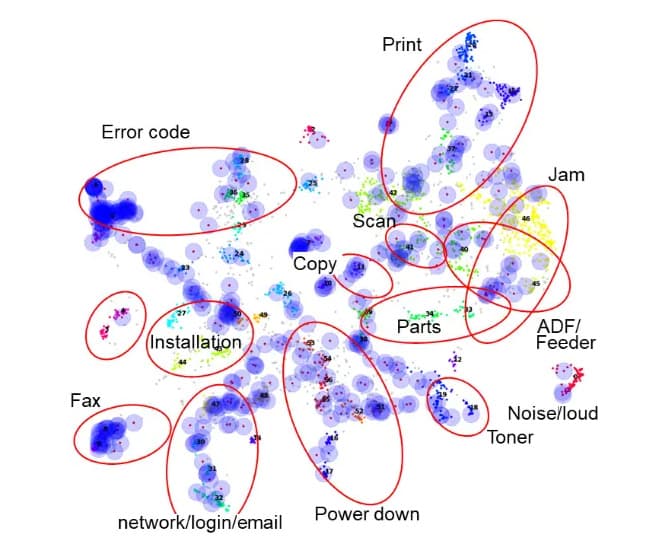
Clustering: NLP can be used to visually show and group multiple documents with similar intents. A visual display of data can lead to faster decision-making and insights as well as assist with identifying knowledge gaps.
Sequence Generation: With sequence generation, the application takes an inquiry (a sentence) and generates a reply. Smart tools, like chats or bots, can enhance customer experiences with fast replies and information.
NLP use case #1: Customer call center workflow
With revenues over $7B, a large food manufacturing company’s call center, which handled over 60,000 calls per month, was overwhelmed and needed to quickly prioritize complaints. It was difficult with their legacy, inaccurate text-mining tool and required significant manual work, especially for the quality assurance department.
Using Ricoh’s integrated solution for a web application, the company automated 98% of its call center workflow. Now, when inquiries come into the call center, a needs analysis transforms the data using classification and regression modules. The computer classifies the call into four categories: compliment, request, advice, or complaint. There are also classifications for food safety (8 types that the computer can select), manufacturing and distribution (5 types or options), and needs categories (4 types) that the application
identifies and routes to the right department. The regression analysis scores and prioritizes the issues depending on the classification types.
Automating the quality assurance checkpoint reduced operation costs, increased quality service, improved data accuracy, and saved 44 hours per month by eliminating manual labor and employees managing the antiquated text-mining tool.
Rising above to deliver excellent customer experiences
These success stories describe how enterprises are not only improving the experiences of customers but how the technology enables their employees to be better at their jobs with the right data and a balanced workload. Intelligent document processing is one of the easiest and most impactful ways to grow your business ― and Ricoh not only offers several solutions based on your requirements, but we’re experts in capturing, understanding, governing, and delivering information to streamline, expedite and protect your business processes.
As both AI and NLP continue to evolve and transform business processes globally, we’re committed to continuous innovation, research and development. It’s already changing the landscape of generative AI, conversational document interaction, natural language querying of content, and AI-assisted workflow orchestration.
What are your biggest business challenges that NLP can tackle?
Get started with NLP and co-innovation.
Recommended for you
 Articles
Navigating NLP for Growth Opportunities
The first article in our innovation series explores today's NLP and generative AI landscape along with ideas on how NLP opportunities lead to growth.

Growth and manufacturing innovation
Enhance manufacturing innovation while supporting healthy manufacturing plant growth by utilizing digital and advanced manufacturing technologies.
 Articles
Benefits of AI-driven insurance claims management
Confronted with a customer now demanding instant gratification, insurers are laser-focused on their automating their claims management processes using AI technology.